 |
||
|
The Long Boat Myth Everyone knows that a longer boat is faster than a short boat. At least that is what I was always lead to believe. When I started designing boats and learning more about hull design I started to read things that made me question this. I quickly realized you have to define what fast means. It sounds obvious, fast is top speed. But what about the typical paddler that never paddles at racing speeds for more than a few seconds at time? Does top speed potential really matter? Maybe that isn't really the best way to look at it. How fast a kayak goes is directly related to the paddlers strength. The better shape your in the faster you can paddle your boat. But top speed doesn't really tell you much since every paddler is different. A better comparison is how much effort it takes to propel a boat at a given speed. Then you can compare one boat to another and know which one requires more effort to paddle at a given speed. I wanted to test this and see what I could discover. I created Basic Boat in my software to use a test bed. I made the bow and stern plumb so that the waterline and boat length were the same for easy comparison. I let the software stretch or shrink the design changing nothing but the length of the boat. Then I ran the numbers. Since a boat is not shaped like a brick, when you change the length you still change other aspects of the hull shape. But these changes have minimal effect and they are directly related to the length of the boat. While not perfect. I thought on this a good bit and this is best method I can come up with. I created a 15' boat and started with that. I let the computer scale it down to 13' and up 17' and 19' long. Then I calculated and charted the resistance for each length. 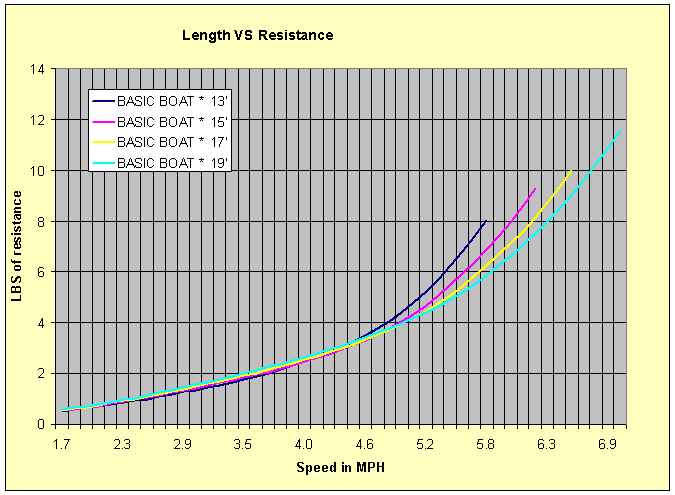 Just a quick look at the chart and you can see the longer hulls are faster. At 8 lbs of resistance the 19 ft. boat would be at least .5 mph faster than the 15 foot version. Meaning for the same amount of effort from the paddler would go faster in the long boat. So long boats are faster. Well, as long as your out putting 8 lbs of force to the boat. But, how many recreation paddlers can keep up these speeds for more than a couple of minutes? From what I have seen, not many, the average recreational paddler travels at around 3 mph with the more experienced probably closer to 4 mph. The number of paddlers that maintain a higher than 4 mph average are a fairly small group. Looking at it that way suddenly the chart looks a little different. Dropping down to the more typical speeds of 3 mph you see something interesting, the 15 foot boat has the advantage. Under approximately 4.5 mph the shorter 15 ft. boat is actually faster (has less resistance) given the same amount of effort. The paddler in the longer boat has to exert more effort to maintain the same speed. 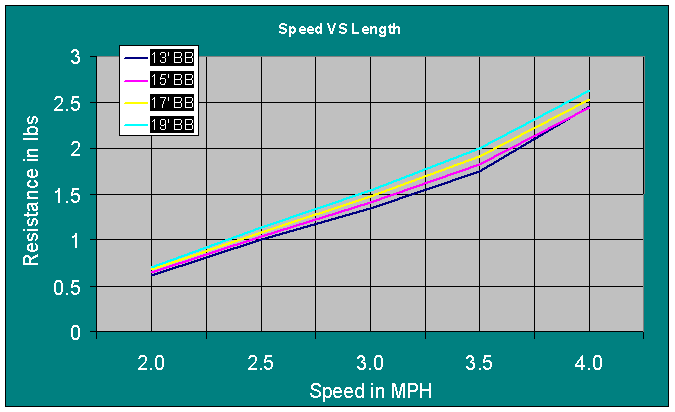 At 2 lbs. of resistance the 15' boat is approximately .4 mph faster than the 21' boat. Meaning if you paddled for 2 hours that would put you almost a mile further down the river for the same amount of effort. The reason for all this is complicated and I don't claim to have a perfect understanding of it. But the main reason for the difference has to do with amount of the hull in the water, or the wetted surface area. The longer boat has more wetted surface (square footage) to drag around than the shorter boat. At the faster speeds the longer length boat and the waves produced by the longer hull being farther apart over rides the wetted surface and give it the advantage then. (told you it is complicated) So, if your the typical paddler you would be better served with the shorter boat. The longer boat is only faster in a sprint and unless your in on of those really strong paddlers that can maintain speeds above 4.5 mph for long periods of time your just dragging around extra hull for that occasional sprint. Keep in mind this this one works when comparing VERY similar hull shapes. In this example the only thing I changed was to stretch the length of the boat. There are a lot of factors other than length that play into a boats design. This will not apply to all boats because of the different hull designs. But it is safe to say that longer is not automatically faster. Shorter may very well be faster for you at the speeds you paddle. So do your homework and don't automatically assume longer is better! REBUTAL (Before you say it) A lot of people want to second guess what I did and say I should have done it differently. Some people think I should change the width when I change the length to keep the stability the same for example. Sound Engineering practice says change one thing , document your changes, then change something else. That way you know that any change you see in the data is because of the what you just changed. If you change width and length and you see changes in resistance, which one caused the changes? No, this doesn't produce a practical boat but that is that is the not the goal. The goal is to learn the effects different lengths have on a design. Once you learn how it effects the boat then you can apply that information to practical boats. Same method can used to test changes in width, hull shapes or any other aspect. It's all about knowledge. There are different ways this could be done. Is mine perfect? Of course not, but the results are valid. If you disagree I welcome you to do your own research and share it with me. That is how we learn. |
||
|